





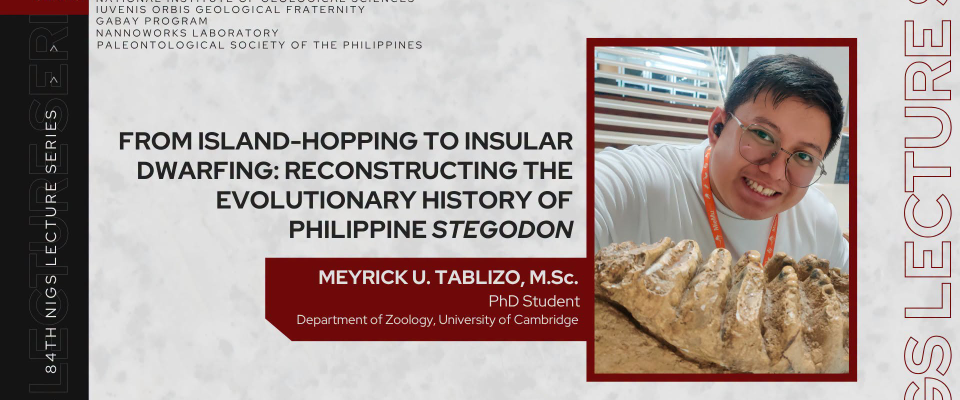
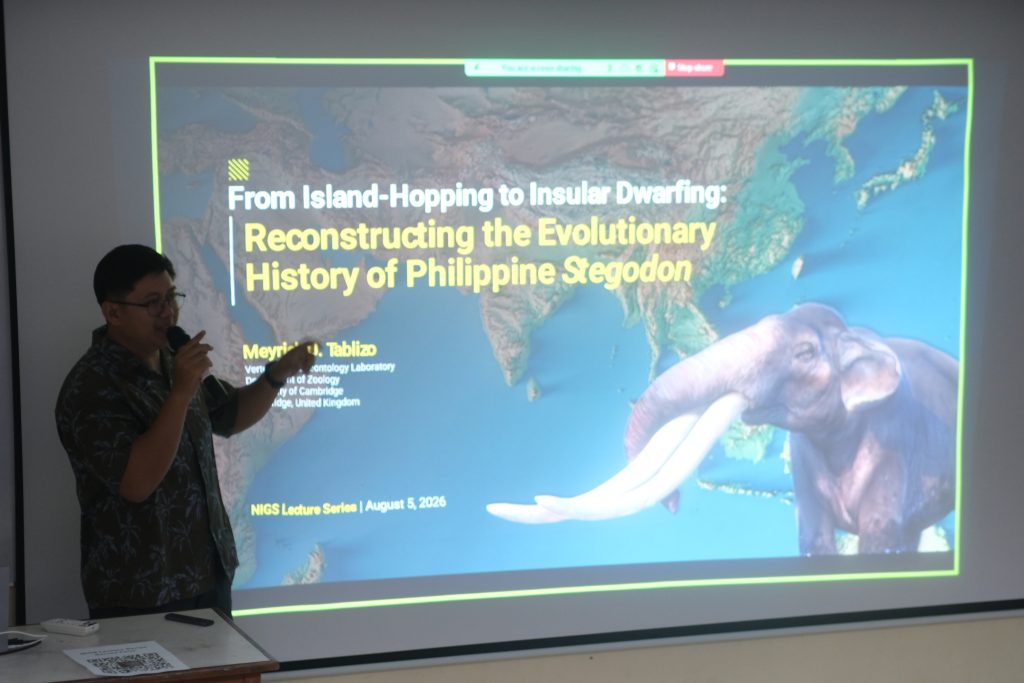
For the 84th installment of the NIGS Lecture Series, the Nannoworks Laboratory invited its alumnus Mr. Meyrick U. Tablizo last August 5, 2026 to deliver a talk on his research “From Island-Hopping to Insular Dwarfing: Reconstructing the Evolutionary History of Philippine Stegodon.” This event was organized in partnership with the National Institute of Geological Sciences, the NIGS GABAY Program, the Nannoworks Laboratory, the Paleontological Society of the Philippines, and the Iuvenis Orbis Geological Fraternity. A recording of the talk is posted below.
Mr. Tablizo highlighted how Philippine Stegodon may have been more diverse than previously recognized and emphasized the significance of the Philippines as a “natural laboratory” that played a significant role in shaping their evolution and migration across Southeast Asia. The talk was held as a hybrid session and was attended by members of the laboratory, the Paleontological Society of the Philippines, the NIGS community, and colleagues from the UP School of Archaeology, Department of Sociology and Anthropology (Ateneo de Manila University), Geology Department-Universiti Malaya, and the National Museum of the Philippines.
Mr. Tablizo earned both his BS and MS in Geology degrees from the National Institute of Geological Sciences, UP Diliman, where he also previously served as an Instructor. He is also a member of the Paleontological Society of the Philippines. Mr. Tablizo is currently a first-year PhD student in the Department of Zoology at the University of Cambridge. His master’s research examined the morphology and taxonomy of proboscidean craniodental fossils from Luzon, while his doctoral research focuses on the evolutionary history, taxonomy, and paleoecology of the extinct proboscidean Stegodon in Asia.
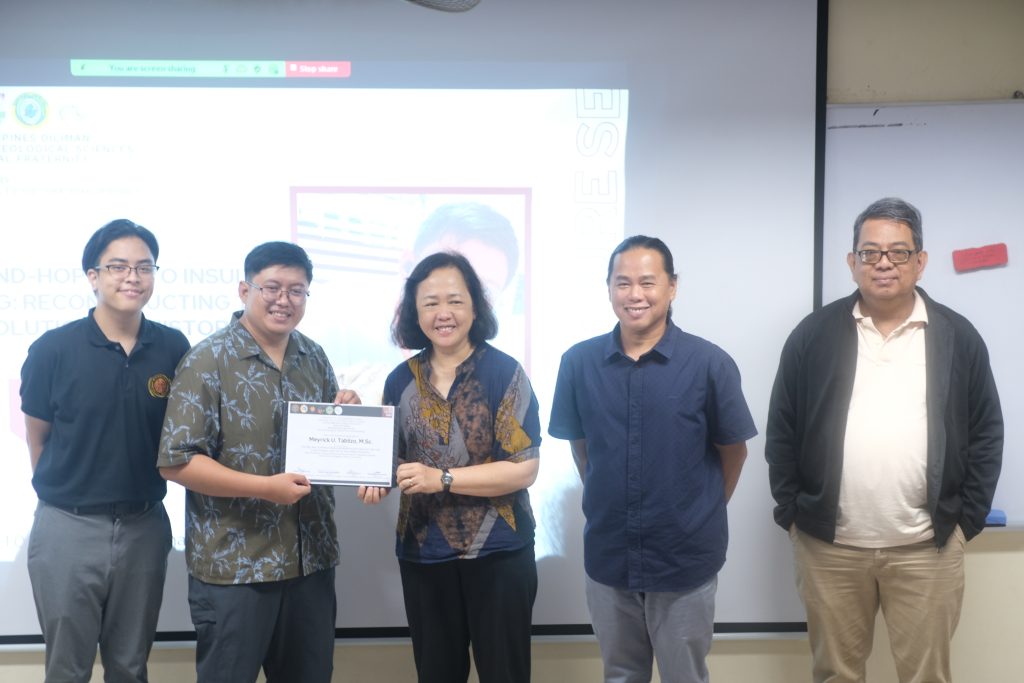
From left to right: Timothy Capulong, Meyrick Tablizo, Dr. Alyssa M. Peleo-Alampay, Dr. Allan Gil S. Fernando, and Dr. Leopoldo P. de Silva, Jr.
ABSTRACT
Stegodon is an extinct relative of modern elephants that inhabited much of Asia, including the Philippines, from the Late Miocene to the Pleistocene. Despite more than a century of fossil discoveries, many questions regarding the taxonomy, evolutionary relationships, palaeoecology, dispersal, and extinction of Philippine Stegodon remain unsolved.
My master’s research reveals that Philippine Stegodon, particularly those from Luzon, exhibited a wider range of body sizes than previously recognized, from relatively large-bodied to dwarfed forms. Craniodental evidence indicates affinities with both Southeast Asian and East Asian Stegodon, while the recently described skull from Solana, Cagayan, suggests a more complex dispersal history involving island-hopping across major biogeographic barriers.
These findings highlight the Philippines as a natural laboratory for studying the evolution of large mammals on oceanic islands, including body-size evolution, adaptation, dispersal, and extinction. Building on this foundation, my doctoral research at the University of Cambridge aims to reconstruct the evolutionary history of Stegodon across Asia by integrating taxonomy, phylogeny, craniodental morphology, palaeoecology, and biogeography.