




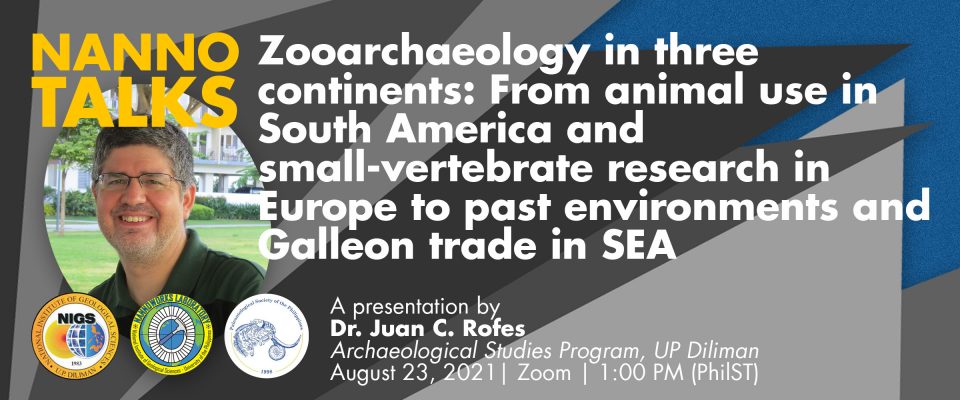
Last August 23, 2021, Dr. Juan C. Rofes of the UP Archaeological Studies Program (ASP) gave a talk on his research on small vertebrates across South America, Europe and Southeast Asia. His presentation is entitled “Zooarchaeology in three continents: From animal use in South America and small-vertebrate research in Europe to past environments and Galleon trade in SEA.” This talk was attended by students and colleagues from the UP National Institute of Geological Sciences (NIGS), UP ASP, and other departments, institutes, and colleges, both within and outside UP Diliman. Colleagues from several government agencies attended the program as well. A recording of the talk is posted below.
The talk was organized by the Nannoworks Laboratory, in collaboration with UP NIGS and the Paleontological Society of the Philippines.
ABSTRACT
In plain words, zooarchaeology is the branch of environmental archaeology dealing with the study of animal remains from archaeological sites. Along the past 25 years, and over three different continents, I have learned how rich and complex this discipline can be. From early studies on the domestication, uses and ritual of South American camelids and guinea pigs in Peru, my country of origin, I moved to Europe where, initially, I focused my research on the systematics, palaeobiology, palaeoecology and biogeography of small mammals, particularly shrews from the well-known Spanish site of Atapuerca. After completing my PhD in Zaragoza, a government grant allowed me to devote to the reconstruction of past environments in the Cantabrian region, mainly based on the evolution of small-vertebrate assemblages from Quaternary caves in northern Iberia. Then, after being awarded a Marie Curie Fellowship of the European Union, I moved to Paris (i.e., MNHN/CNRS), where my research turned to understand the biogeographical histories and the effects of anthropization on populations of small mammals during the late Quaternary in Western Europe. Finally, three years ago, I was appointed as an associate professor at the Archaeological Studies Program of the University of the Philippines. Putting together all that I have learned before, I am currently delving into the systematics, biogeography and palaeoecology of the small mammals from Callao Cave (Cagayan Valley) in order to understand the interactions between environmental change and human development in Luzon during the last 70 thousand years. In parallel, I am developing a binational project to investigate the faunal translocations from the New World to SEA and vice versa in the frame of the Galleon trade and the environmental impacts of the latter over the Philippine Islands.