





By Jayce Eunice B. Salvador
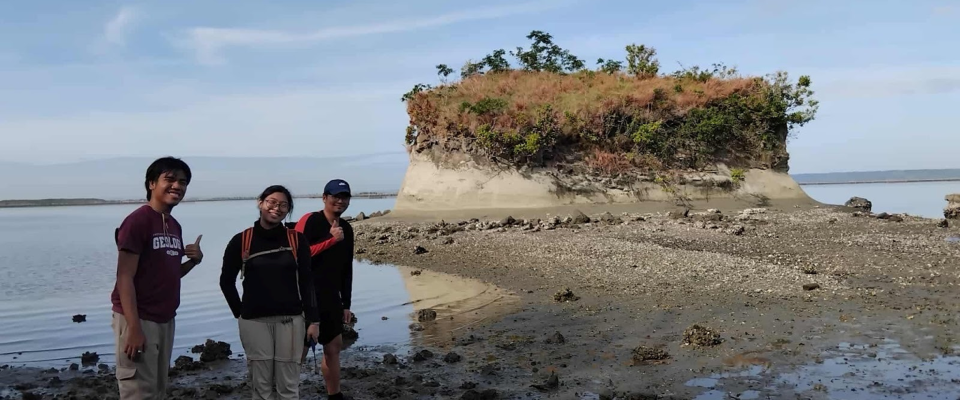
Members of the Nannoworks Laboratory at Pusong Island, Anda (from left): John Dominique Pagay, Jayce Eunice Salvador, and Toby Vergara.
From February 15 to 16, 2026, the Nannoworks Laboratory conducted fieldwork in the province of Pangasinan. Led by Dr. Allan Gil Fernando, the team is composed of Toby Vergara, Jayce Eunice Salvador, and John Dominique Pagay who visited several identified fossil sites to collect rock samples and fossils for undergraduate and graduate research within the laboratory. The results of the students’ respective special topics—including calcareous nannofossil biostratigraphy, foraminiferal analysis, ostracod and brachiopod identification—aim to provide new insights into the paleoenvironment and geological history of the area.
The group visited outcrops in Bani, Bolinao, and Anda, Pangasinan, collecting samples from the Pliocene–Pleistocene rock units exposed in the region. One notable site was an exposure in Barangay Culang, Bolinao, which contains excellently preserved fossil mollusks. Additional samples were collected from Pusong Island and from an exposure within a fishpond in Barangay Awile, Anda. These outcrops correspond to the Pliocene interbedded clastic deposits of the area, with calcareous nannofossil analysis indicating an Early Pliocene age. The team also observed and sampled the Bolinao Limestone, a fossiliferous limestone unit of Pliocene–Pleistocene age.
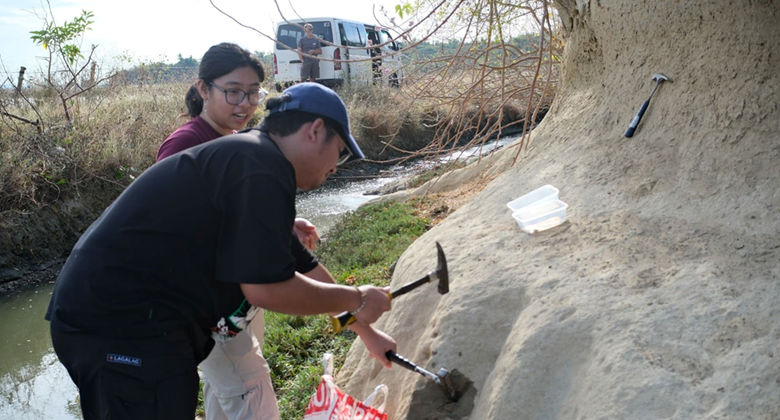
Jayce Salvador and Toby Vergara during the sample collection of the Plio-Pleistocene interbedded clastics at Brgy. Awile, Anda.
Despite the limited time in the field, the activity was productive and yielded numerous rock and fossil samples. The trip also provided valuable learning opportunities outside the classroom. Overall, the island of Pangasinan remains an excellent site for the study of fossils and continues to contribute to the advancement of paleontological research in the Philippines. The area has yielded a diverse range of fossil groups that have been studied and continue to be examined—from brachiopods, ostracods, and foraminifera to shark teeth.