






By Raphael Francis E. Dequilla and Dr. Allan Gil S. Fernando
From November 28 to December 1, 2025, third-year undergraduate students of the National Institute of Geological Sciences (UP-NIGS) participated in the annual Geology 120 (Stratigraphy and Sedimentology) fieldwork in the Ilocos Region. During the activity, the class visited various outcrops and Recent sedimentary environments across the region to study and interpret the depositional processes and histories represented by these sites as well as their respective paleoenvironments. The fieldwork was led by Dr. Sandra G. Catane, Dr. Leopoldo P. de Silva, Jr., and Dr. Allan Gil S. Fernando, with assistance from Instructors and URAs of NIGS: Mr. Raphael Francis E. Dequilla, Mr. Audric Brian R. Gardoña, Ms. Andrea Denise A. Pamintuan, Ms. Francesca C. Petero, Mr. Andrei Ross M. de Jesus, and Mr. Toby L. Vergara. The class activity also marked Dr. Catane’s last Geol 120 fieldwork as she is set to retire at the end of AY 2025-2026. To commemorate the occasion, the class surprised Dr. Catane with a special tarpaulin, which was featured in photo documentation across several visited outcrops.
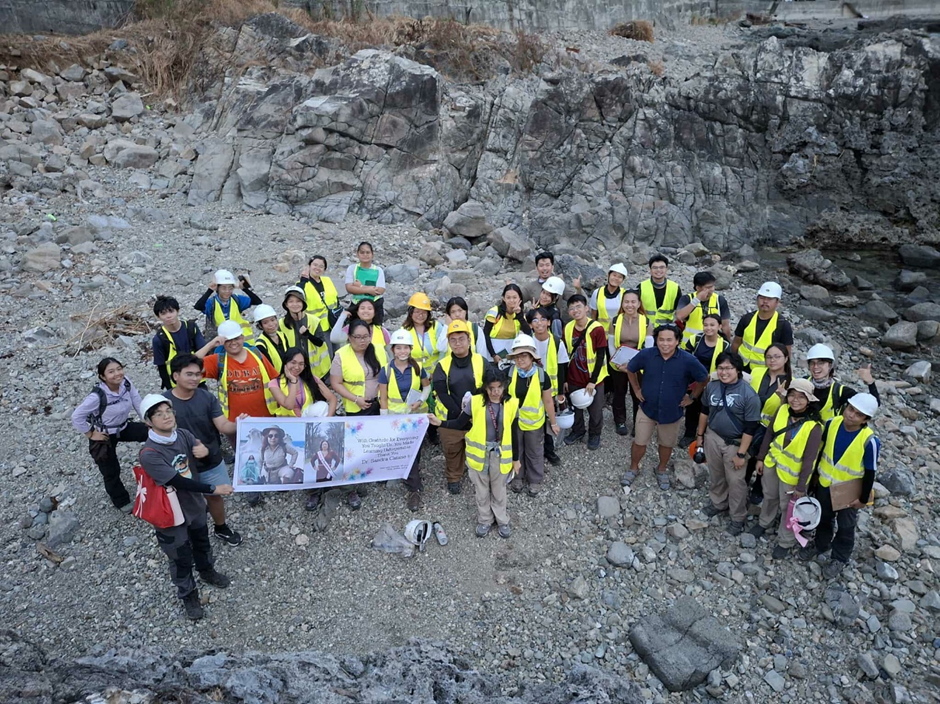
The Geology 120 students, faculty, and staff posing for a photograph featuring a “Thank You” tarp for Dr. Catane in Solvec Point, Narvacan, Ilocos Sur during the first day of the fieldwork. Photo by Timothy Capulong.
The first day consisted of observing and describing in detail outcrops exposed along the Abra River and Solvec Point (Narvacan), both in Ilocos Sur. The class used different stratigraphic principles to infer the succession and relative ages of the lithologic units exposed in Solvec Point. The second day saw the batch head to Ilocos Norte to observe Recent sedimentary environments such as the Paoay Lake and the La Paz Sand Dunes, the calcarenites (Kapurpurawan Rock Formation), volcanic rocks, and lava flows in Burgos, and the mélange near Baruyen Bridge in Bangui. The second day of the fieldwork concluded with a nice sunset view in the La Paz Sand Dunes in Laoag where an earlier discussion on “eolian” sedimentary processes and the formation of the Paoay Lake in relation to the formation of the sand dunes was conducted.
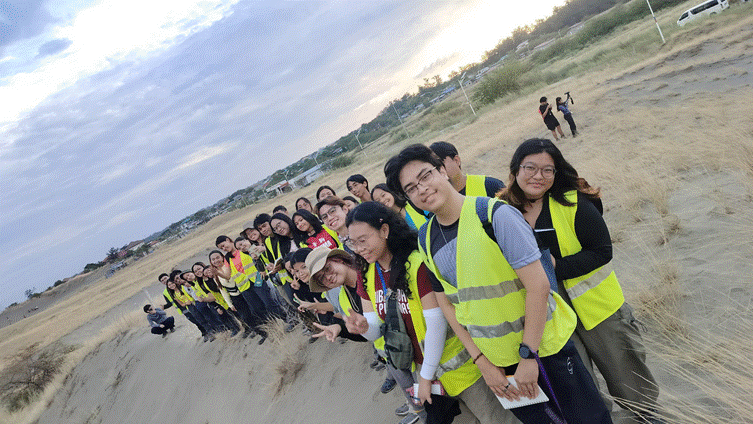
The Geology 120 students posing for a photo on top of a dune in the La Paz Sand Dunes, Ilocos Norte. Photo by Raphael Dequilla.
Several outcrops were visited in Magsingal, Sta. Maria, and Santiago in Ilocos Sur during the third day. Among the outcrops observed include debris flow, gravity flow, and mass transport deposits, as well as shallow intrusives and allodapic limestones. Before going back to Manila on the fourth day of the fieldwork, the class visited Luna Beach, where discussions on gravel morphology, sediment provenance, and beach rocks were conducted, followed by a quick tour to Immuki Island in Balaoan, La Union to observe coral microatolls. The last outcrop visited was an exposure along the San Fernando Bypass Road where an exercise on determining the top and bottom of beds was conducted. The fieldwork formally concluded upon the group’s arrival at UP-NIGS on the evening of 4 December 2025, with all objectives successfully met and all participants returning safely.
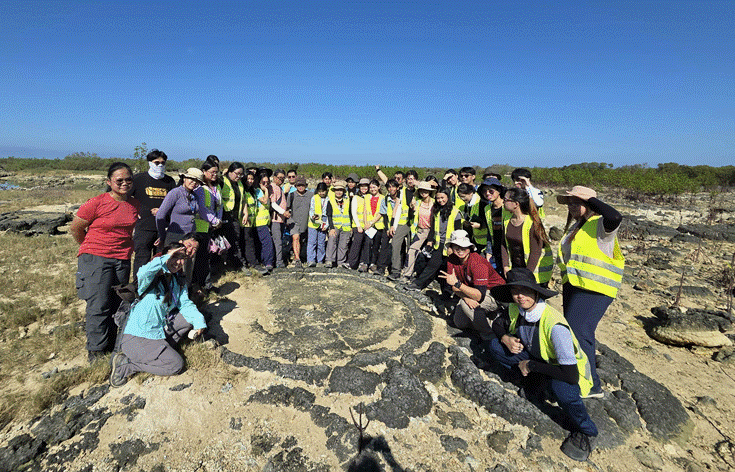
Students and faculty posing for a photo with a coral microatoll on Immuki Island, Balaoan, La Union, during the fourth day of the fieldwork. Photo by Toby Vergara.